Love the Only Space Agains the Barbary
The Brutal Barbary Pirates: The Violent Nuisance of the Christian Ships
During the period of 250 years, the Barbary pirates enslaved 1.25 million Christians
 F rom the 16th to the 18th century, the Spanish Empire and the Ottoman Empire fought a proxy war in the Mediterranean through piracy. The Barbary pirates, operating from the western coasts of North Africa, raided European coastal towns and attacked Christian ships all the way up to Iceland.
Between 1530 and 1780, the Barbary pirates enslaved 1.25 million Europeans.
There were so many captured Europeans in the Arab slave markets you could get a Christian slave for the price of an onion.
The curious phenomenon of the pirate states

The coast of North Africa was known as the Barbary Coast, a term derived from the name of its Berber inhabitants.
The Barbary pirates established three powerful pirate states on the coast of North Africa — in Algiers, Tunis, and Tripoli.
The Barbary States were called Ottoman Tunis, Regency of Algiers, and the Kingdom of Tripoli. There was also the short-lived Republic of Sale in Morocco.
The Barbary States main source of income was piracy and slave trade.
In the 17th century, the city of Algiers had 10,000, the city of Tripolis 2,500, and the city of Tunis 3,000 pirates. Several thousands more lived in smaller coastal towns such as Sale in Morocco.
Eventually, the towns of Tripoli, Algiers, and Tunis gained so much independence from the Ottoman Empire, they were part of the empire only in name.
The Barbary pirate states functioned like modern stock companies
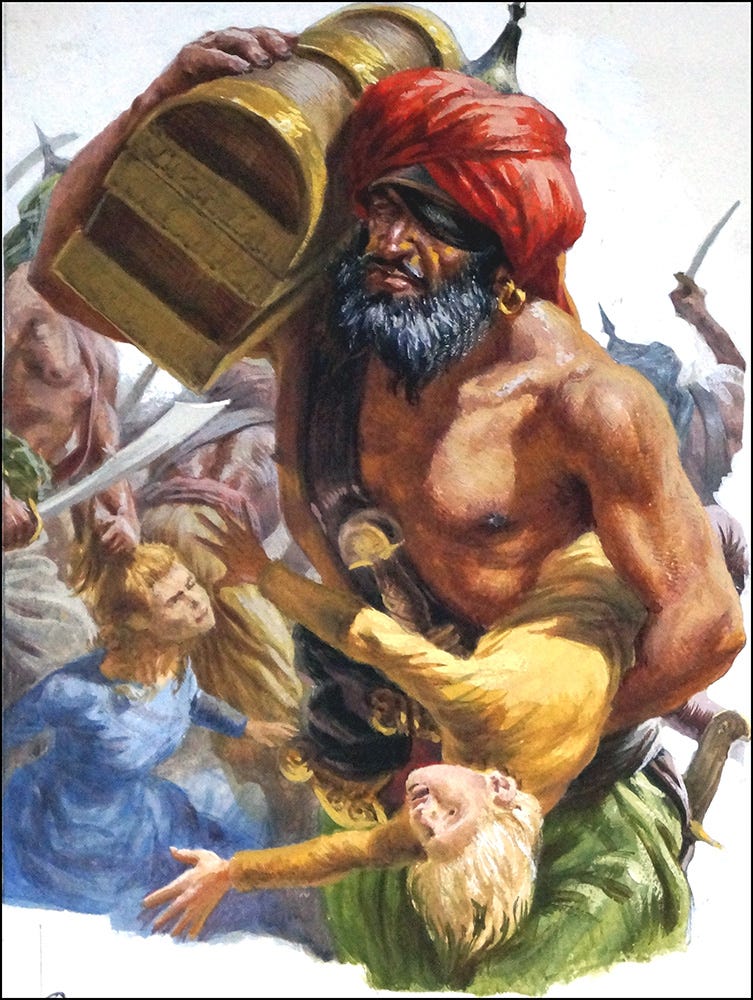
The Barbary States were well organized.
The pirate business model had a recruitment system, military hierarchy, private and public funding, coordinated piracy operations, and slave and ransom markets.
Investors bought shares of pirate enterprise. The raised money was used for ships, crews, supplies, and ammunition.
The same as in the modern stock company, each shareholder received part of the loot, depending on how big share of the pirate enterprise he had.
After a successful pirate raid, the ships returned to their home port and divided the loot.
Shares of the loot were paid to the Barbary State and its officials, a share went to the investors, and the rest of the loot was kept by the captain and the crew.
Captured Christians were sold as slaves or released after a hefty ransom from Europe. The ships and their cargo were put on auction.
Lots of Barbary pirates were converted Christians

Interestingly, the Barbary pirates weren't only Arabs and Turks. Lots of them were renegades from Albania, Corsica, Greece, and Syria.
The renegades were former Christians who fled and converted to Islam. Needless to say, the Islam was loosely practiced in the Barbary States.
In 1634, in Algiers alone lived 8,000 renegades.
The Jews and the Moriscos, the baptized Muslims, settled in the Barbary States to escape persecution from the Spanish inquisition. They exacted their revenge on the Spaniards by attacking their ships.
Once a pirate, always a pirate

A privateer was an individual who performed acts of piracy on behalf of a certain state against the state's opponents. For example, English privateers were attacking the Spanish ships.
There was an ongoing collaboration between Protestant and Muslim pirates against the Catholic ships.
However, when the hostilities between the Protestants and the Catholics ended, the Protestant pirates simply sailed to the Barbary Coast, converted to Islam, and began raiding the Christian ships.
The Protestant pirates serving the Barbary States made a fabulous fortune attacking the Christian ships.
The European pirates brought a vast experience of gunnery and naval navigation to the Barbary pirates.
The European Barbary pirates were legendary

One of the best-known Barbary captains was John Ward, who was initially a privateer in the service of Queen Elizabeth I, but later joined the Barbary pirates and took the Muslim name of Yusuf Reis.
Among others, he introduced modern square-rigged ships to the Barbary pirates, which were much more efficient than galleys.
Ward got extremely rich from years of piracy.
John Ward was an inspiration for Captain Jack Sparrow in the Pirates of the Caribbean films.
Another famous Barbary pirate captain from Europe was Dutch privateer Simon the Dancer (1579-1615). His Turkish name was Simon Re'is. He captured ships all the way up to Iceland.
Another Dutchman, Jan van Haarlem (1570-1641), successfully raided Iceland and Ireland. He was known by his Muslim name, Reis Mourad the Younger.
The golden age of the Barbary pirates
Between 1530 and 1780, the Barbary pirates enslaved 1.25 million Europeans.
The captured men became galley slaves (as oarsmen) and women were sold as sex slaves.
Among others, Miguel Cervantes, the famous author of Don Quixote, was a prisoner of the Barbary pirates from 1575 to 1580.
The coastal regions between Malaga in Spain and Venice in Italy were raided so often there was no one left to capture anymore.
For example, in 1551, the Barbary pirates enslaved everyone living on the Maltese island of Gozo, 6,000 people altogether.
European states and even the United States of America were paying enormous annual tributes to the Barbary pirates in exchange for the safe passage of their ships.
"… there is no other occupation more profitable and more prosperous than sailing the sea, since, as they say, everything necessary for life can be found on foreign ships…"
— Father Pierre Dan about the Barbary pirates
After the final defeat of Napoleon, the European superpowers destroyed the Barbary pirates

Eventually, the European superpowers had enough of the Barbary pirates.
In the 19th century, the western nations built warships that were technologically superior to the Barbary ships.
But it was only after the final defeat of Napoleon in 1815, the European countries in collaboration with the United States crushed the Barbary pirates once for all.
The navy of the United States fought two wars with the Barbary pirates — the First Barbary War (1801-1805) and the Second Barbary War (1815-1816).
In 1830, France occupied Algiers, followed by Tunisia in 1881.
Conclusion
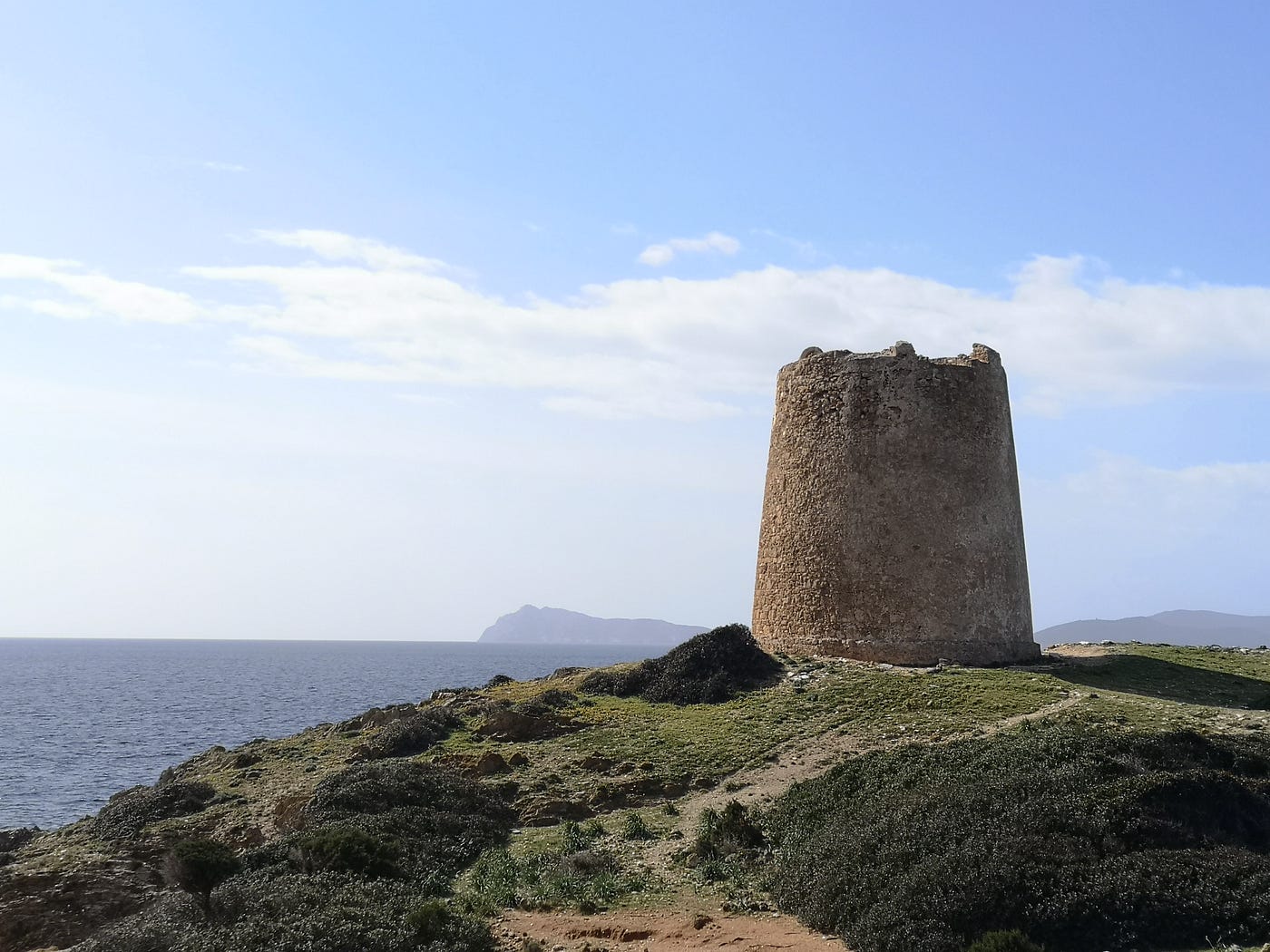
In February 2022, I spent ten days in Sardinia, a medium-sized Italian island near Sicily.
I noticed the western and southern coasts were sprinkled with remnants of defensive towers. These towers were built in an elevated position overlooking a bay beneath. The towers were within sight distance of each other.
Soon, I learned the towers were built by the Spanish Empire as a defense against the Barbary pirates.
Once they served as a protection against the pirates, today they serve as a tourist attraction.
Source: https://historyofyesterday.com/barbary-pirates-9216f6a7185
0 Response to "Love the Only Space Agains the Barbary"
Post a Comment